
Is Sydney or Melbourne Larger? A Deep Dive Into Australia's Two Great Cities
Is Sydney or Melbourne larger? We compare population, land area, economy, and growth rates to reveal what the numbers actually say about Australia's two biggest cities.
Guides
2026-04-04
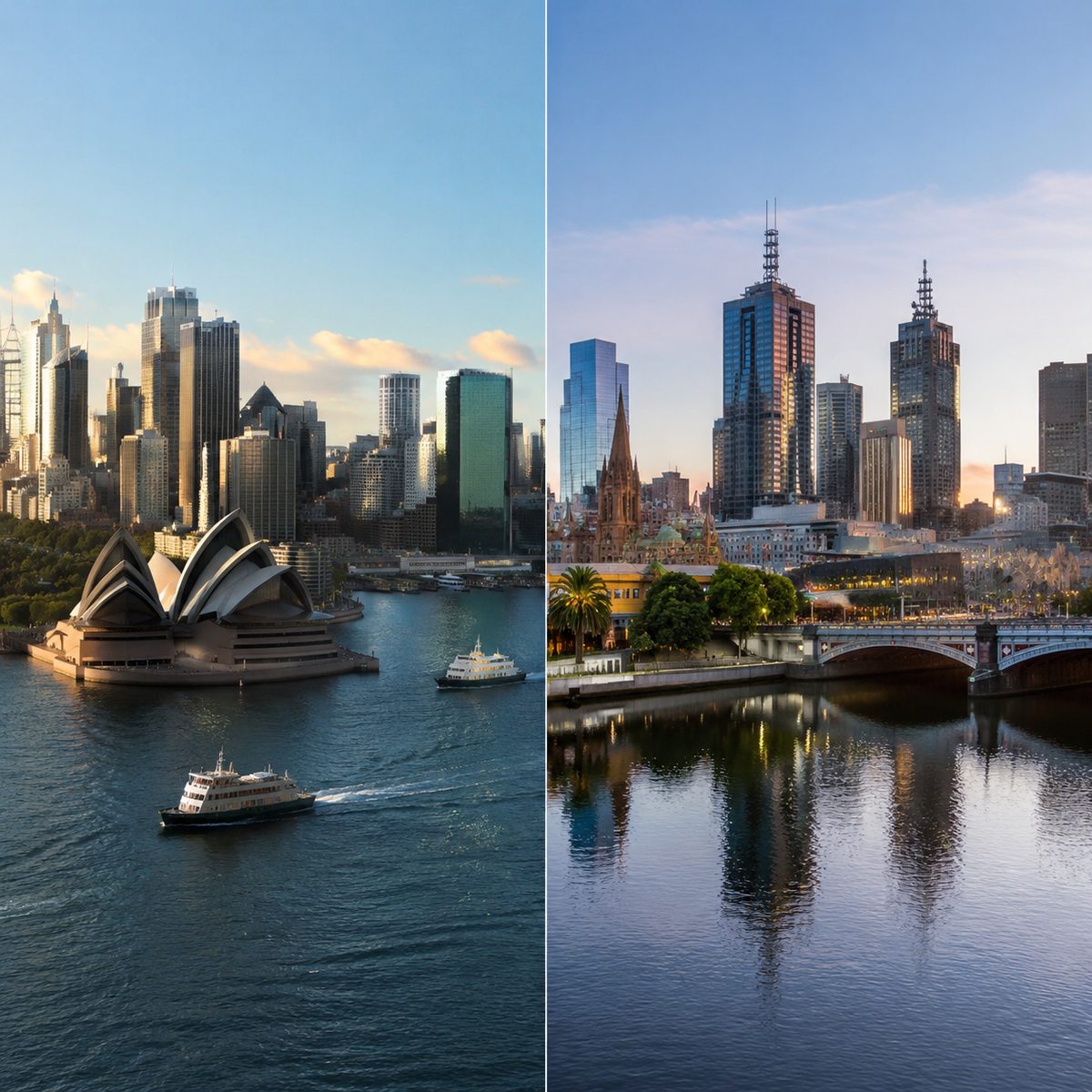
Australians have been arguing about this for over a century. The Sydney-Melbourne rivalry is baked into the national character — it shaped where we put the capital, how we built our railways, and how two cities developed entirely different personalities despite sitting on the same continent. But when you ask which city is actually larger, the answer depends entirely on what you mean by larger. Population? Land? Economic output? Growth trajectory? Each measure tells a different story, and together they reveal something genuinely interesting about how Australian urbanism evolved.
Population: Sydney Still Leads, But the Gap Is Closing Fast
Sydney holds the title on raw population. As of the most recent Australian Bureau of Statistics estimates, Greater Sydney sits at approximately 5.3 million people, while Greater Melbourne comes in around 5.1 million. That gap — roughly 200,000 people — sounds comfortable until you look at the trend line.
Melbourne has been growing faster than Sydney for most of the past decade. Before COVID disrupted migration patterns, Melbourne was adding people at a rate that had demographers confidently predicting it would overtake Sydney as Australia's most populous city sometime in the 2030s. The pandemic scrambled those projections — Melbourne's hard lockdowns slowed interstate migration, and Sydney absorbed a larger share of returning overseas migrants initially. But the underlying dynamics reasserted themselves quickly.
The question of whether Melbourne is growing faster than Sydney is not really in dispute. Melbourne's population growth rate has consistently outpaced Sydney's. The drivers are structural: Melbourne has more affordable housing on its urban fringe, a stronger tradition of greenfield development, and a planning framework that has historically accommodated outward expansion. Sydney is hemmed in by geography — the Blue Mountains to the west, national parks to the north and south, and the ocean to the east. Melbourne sits on a flat basalt plain with few natural constraints on expansion.
If current trends hold, Melbourne will likely become Australia's largest city by population within the next fifteen to twenty years. That is not a prediction — it is a projection based on observed growth rates. Whether it actually happens depends on housing policy, infrastructure investment, and migration patterns that no one can fully forecast.
Land Area: Melbourne Is Substantially Bigger
This is where the comparison flips decisively. Melbourne is significantly larger than Sydney in land area. Greater Melbourne covers approximately 9,990 square kilometres. Greater Sydney covers around 12,368 square kilometres by some measures — but this figure is contested and depends heavily on how you define the metropolitan boundary.
When you use consistent metropolitan boundary definitions, Melbourne's urban footprint is vast. The city sprawls across the Mornington Peninsula to the south, out to Melton and Wyndham in the west, and up through the Yarra Valley to the east. This sprawl is not accidental. It reflects deliberate planning decisions made across the twentieth century that prioritised the quarter-acre block as the Australian ideal.
The consequence of that sprawl is a city with relatively low population density by global standards. Comparing Sydney and Melbourne in terms of city density reveals a meaningful difference: Sydney is noticeably denser. Sydney's geography forced density — you cannot spread endlessly when you have a harbour cutting through the middle of your city and sandstone ridges limiting development. Melbourne had no such constraint, and it shows in the suburban fabric.
Sydney's inner suburbs are dense, walkable, and built around a transit spine that predates the car. Melbourne's inner suburbs share some of those qualities — the tram network is genuinely world-class — but the middle and outer suburbs are overwhelmingly low-density, car-dependent, and built to a scale that makes public transport provision genuinely difficult. This is not a criticism. It is a description of how two cities made different choices under different geographic and political conditions.
Which City Is the Capital of Australia?
Neither. This question comes up constantly, and it reflects a genuine confusion that has its roots in the Sydney-Melbourne rivalry itself. Canberra is the capital of Australia, and the reason Canberra exists at all is precisely because Sydney and Melbourne could not agree on which of them should hold that status.
When the Australian colonies federated in 1901, the rivalry between the two cities was so intense that the Constitution included a compromise: the capital would be in New South Wales, but at least 100 miles from Sydney. Melbourne served as the temporary seat of government while Canberra was planned and built. Parliament finally moved to Canberra in 1927. The whole episode is a perfect illustration of how seriously both cities took their competition — seriously enough to deny either of them the prize.
Sydney is the capital of New South Wales. Melbourne is the capital of Victoria. Canberra is the national capital. That is the answer, and the history behind it is more interesting than the answer itself.
Economic Size: Sydney's Financial Dominance Versus Melbourne's Diversified Base
Comparing Sydney and Melbourne economically requires separating different kinds of economic activity. Sydney has a larger gross metropolitan product. It is Australia's financial capital — the headquarters of the major banks, the ASX, the bulk of the legal and professional services sector. If you are measuring the concentration of high-value financial services, Sydney wins clearly.
But Melbourne's economy is more diversified. It has a stronger manufacturing heritage, a larger share of the education sector, a more developed creative industries cluster, and a port that handles more container traffic than Sydney's. Melbourne's economy is less exposed to the volatility of financial services cycles. Whether that makes it larger or simply different depends on what you value.
By GDP, Sydney's economy is larger — roughly $450 billion versus Melbourne's $380 billion in recent estimates, though these figures shift with methodology and timing. But Melbourne has been closing that gap too, for the same reasons it has been closing the population gap: faster growth, more affordable business costs in many sectors, and a quality of life proposition that continues to attract skilled workers and investment.
The economic comparison also looks different at the neighbourhood level. Melbourne's CBD is genuinely one of the most economically active urban cores in the Asia-Pacific. The concentration of universities, hospitals, cultural institutions, and corporate headquarters within a compact central area gives Melbourne an economic density in its core that rivals Sydney's despite the city's overall lower density profile.
What the Rivalry Actually Reveals About Australian Urbanism
The Sydney-Melbourne comparison is not really about which city is bigger. It is about two different models of how a city can work.
Sydney developed around its harbour. The geography imposed a certain kind of city — dense, fragmented, expensive, spectacular. The harbour is both Sydney's greatest asset and its greatest constraint. It creates extraordinary amenity and impossible traffic. It produces some of the most valuable real estate on earth and some of the most intractable planning problems.
Melbourne developed around its grid. The Hoddle Grid at the centre, the tram network radiating outward, the suburban expansion following the rail lines and then the freeways. Melbourne is a city you can understand from a map. Sydney is a city that defeats maps. This is not metaphor — it is a genuine difference in urban legibility that shapes how people experience and move through each city.
The tram network is worth dwelling on. Melbourne operates the largest tram network in the world outside of a handful of European cities. It is the circulatory system of the inner city, and it is one of the reasons Melbourne's inner suburbs function as well as they do. The network was nearly dismantled in the 1970s — the same fate that befell tram systems in Sydney and most other Australian cities. Melbourne kept it, and that decision has compounded in value for fifty years.
For anyone moving through Melbourne today, the tram network is not just transport infrastructure. It is the connective tissue of a particular kind of urban life — one that allows density without the full weight of underground rail investment, that keeps streets active, and that gives the city a human scale even as it grows.
Growth Pressures and What Comes Next
Both cities are under enormous pressure. Housing affordability has deteriorated sharply in both places over the past two decades. Infrastructure has struggled to keep pace with population growth. The question of how to accommodate more people without destroying what makes each city worth living in is the central urban policy challenge of the next generation.
Melbourne's response has been a combination of continued fringe expansion and increasing density in the inner and middle suburbs. The latter is contested — established residents resist densification, and the planning system has historically given them significant power to block it. But the pressure is building. The alternative — endless sprawl across the basalt plain — has real costs in infrastructure, commute times, and carbon emissions that are becoming harder to ignore.
Sydney faces a harder version of the same problem. The geography that makes it beautiful also makes it expensive to build in. Every new housing development requires expensive infrastructure. The city has been trying to shift growth toward its western suburbs for decades, with mixed results. The opening of the Metro West line will change some of that calculus, but the fundamental tension between Sydney's geography and its housing needs is not going away.
Melbourne's growth trajectory — faster population growth, more land, lower density, a planning framework under pressure to change — makes it the more dynamic story right now. Whether that dynamism translates into Melbourne overtaking Sydney on the measures that matter most is a question that will be answered over the next twenty years, not today.
So Which Is Larger?
Sydney is larger by population, for now. Melbourne is larger by land area. Sydney has a bigger economy in absolute terms. Melbourne is growing faster on almost every measure. Neither is the national capital.
The honest answer is that the question is less interesting than the comparison it prompts. These are two cities that developed differently, made different choices, and produced different urban environments. Sydney is denser, more expensive, more geographically dramatic. Melbourne is more sprawling, more affordable in relative terms, more legible in its structure, and growing faster.
If you are asking which city will be larger in thirty years, the evidence points to Melbourne. If you are asking which city is larger today, Sydney still holds the population lead. If you are asking which city has the better tram network, that one is not close.
Related Articles
Continue reading: What to do in 4 days in Melbourne?, Which is the most beautiful town in Australia?.
Need professional help? Visit our services page.