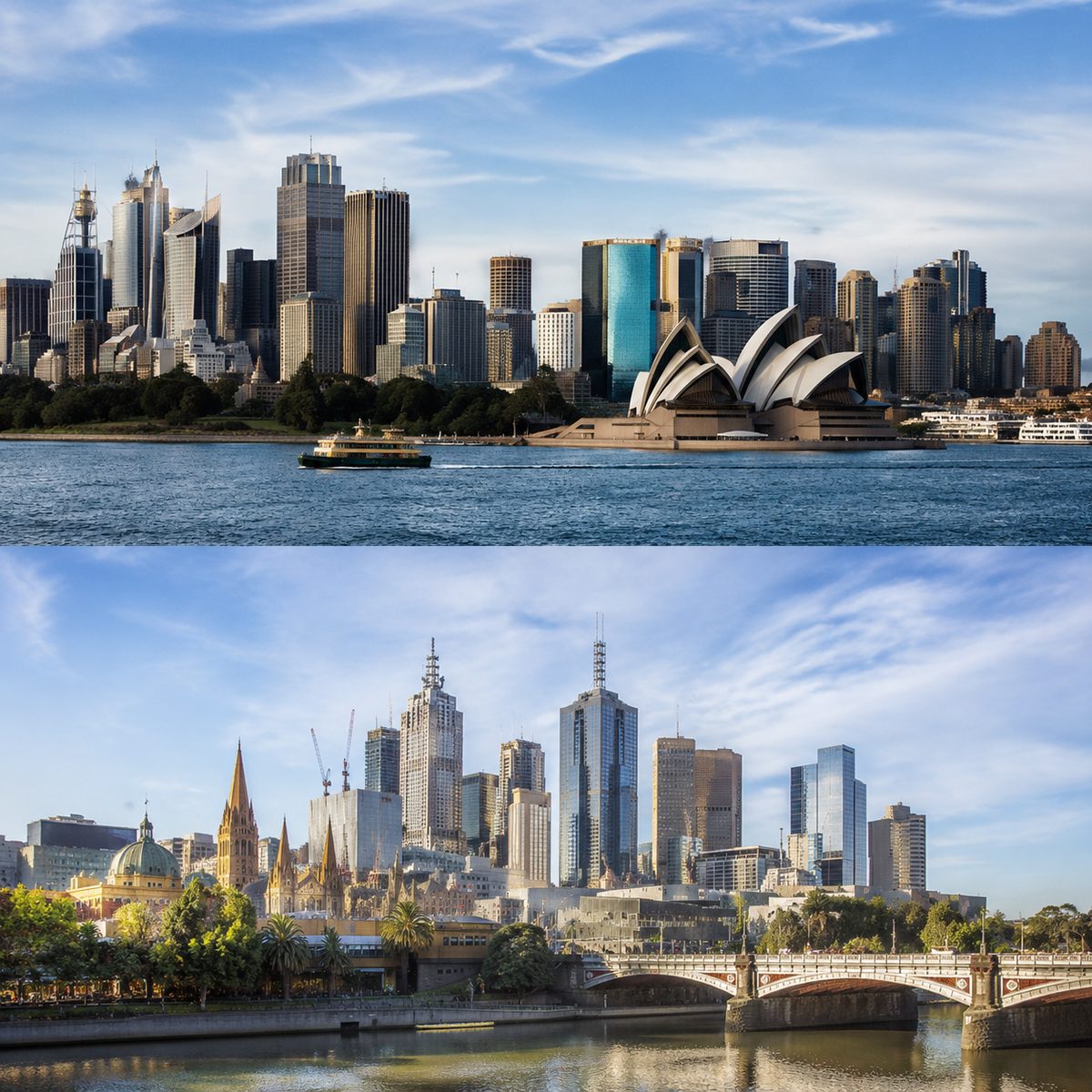
Most Australians would say yes without blinking. Sydney is bigger. Everyone knows that. It has the Opera House, the Harbour Bridge, the famous postcard skyline. It got the 2000 Olympics. It feels like the big one.
But the story is more complicated than that. And if you look at the numbers carefully, the answer depends entirely on what you mean by bigger.
Population? Land area? Density? Growth rate? Each measure tells a different story. And one of those stories is genuinely shocking if you have always assumed Sydney wins everything.
The Population Picture Right Now
Sydney is still the most populous city in Australia. That part is true. As of the most recent census data, Sydney holds around 5.3 million people. Melbourne sits at roughly 5.1 million.
That gap sounds comfortable. It is not. Twenty years ago Sydney led by nearly a million people. The gap has been closing fast, and the trajectory is unmistakable.
So yes, is Sydney a bigger city than Melbourne by population? Currently, yes. But only just. And probably not for much longer.
Melbourne Is Growing Faster. Much Faster.
This is where the story gets interesting. Melbourne has been growing at a rate that consistently outpaces Sydney. Before the pandemic disrupted migration patterns, Melbourne was adding people at a pace that had demographers predicting it would overtake Sydney by the early 2030s.
The pandemic shuffled the deck. Interstate migration shifted. International student flows changed. But the underlying trend reasserted itself quickly once borders reopened.
Melbourne's growth is driven by a few things working together. Strong international migration, particularly from South and Southeast Asia. A relatively younger population that is having children. And a reputation as a liveable, culturally rich city that attracts people who have choices about where they settle.
Sydney's growth has not stopped. But it has slowed. Housing costs play a role in that. So does the geography of the city, which we will get to shortly.
The projection that Melbourne will become Australia's largest city is not fringe speculation. It is the mainstream view among urban planners and demographers. The question is when, not if.
Land Area Is Where Sydney Absolutely Dominates
Here is the number that surprises people. Sydney's metropolitan area covers roughly 12,000 square kilometres. Melbourne's covers around 9,900 square kilometres.
Sydney is physically much larger. That extra land area reflects the geography of the place. Sydney is hemmed in by the Blue Mountains to the west, the Royal National Park to the south, and the Hawkesbury River system to the north. The city has had to sprawl in the directions it can, and it has done so dramatically.
Melbourne sits on the flat basalt plains of the Port Phillip basin. It can expand in almost any direction. And it has. The outer suburbs of Melbourne now reach places that would have seemed impossibly distant from the city centre a generation ago. Suburbs like Clyde North, Wollert and Rockbank are growing at rates that strain every piece of infrastructure connecting them to the rest of the city.
But even with that expansion, Melbourne's footprint remains smaller than Sydney's. Sydney simply covers more ground.
Density Tells a Different Story Again
Take the population of each city and divide it by the land area and you get density. This is where Melbourne and Sydney swap positions again.
Melbourne is more densely populated than Sydney. More people per square kilometre. That reflects the compact nature of Melbourne's inner and middle suburbs, the apartment boom that has transformed areas like Southbank, Docklands, Carlton and Brunswick, and the way Melbourne's growth has concentrated in corridors rather than spreading evenly across the landscape.
Sydney's lower density is partly a product of its geography. The city has large areas of national park, water, and steep terrain that cannot be built on. Those areas drag the average density down even as the built-up parts of Sydney are intensely crowded.
The density difference matters for how each city functions. A denser city can support more frequent public transport. It can sustain more local shops and services within walking distance. It tends to produce shorter average trip times even if the city feels more crowded.
Melbourne's train network, operated by Metro Trains and connected to the broader public transport system through Metlink Melbourne, serves a city where density makes frequent services viable across a wide area. The network carries millions of trips each year precisely because the population is concentrated enough to fill trains.
Which City Is Actually the Capital of Australia?
Neither of them. This question comes up constantly and the answer is Canberra.
Canberra became the national capital in 1913, chosen specifically because Sydney and Melbourne could not agree on which of them deserved the honour. The compromise was a purpose-built city roughly equidistant between the two rivals, sitting in the Australian Capital Territory.
Sydney is the capital of New South Wales. Melbourne is the capital of Victoria. Both are state capitals with significant administrative functions. But the federal parliament, the High Court, the Reserve Bank headquarters and the official residences of the Governor-General and Prime Minister are all in Canberra.
The confusion is understandable. Sydney has the international profile. Melbourne has the cultural weight. Canberra has the actual government. Australia is unusual in having its largest city and its capital city be different places, but it is not unique. The United States, Brazil, Canada and several other countries made the same choice for similar reasons.
The Cost of Living Question
Sydney is more expensive than Melbourne. That is the short answer and it has been consistently true for a long time.
Sydney's median house prices have historically run ahead of Melbourne's. The gap narrows and widens depending on market conditions, but Sydney has maintained a premium that reflects its status as the financial capital of Australia and the gateway city for international arrivals.
Rents follow the same pattern. A comparable apartment in inner Sydney will typically cost more than the same apartment in inner Melbourne. The difference is not trivial. For people making decisions about where to live and work, the cost gap is a real factor.
This cost difference is one reason Melbourne has been able to attract migrants and interstate movers who might otherwise have chosen Sydney. The lifestyle offer is comparable. The cultural scene is arguably richer. The coffee is better, Melburnians will tell you with complete sincerity. And you can afford to actually live there.
The cost gap also shapes how each city grows. Sydney's high housing costs push growth outward to distant suburbs and satellite cities. Melbourne's slightly lower costs have allowed more growth to occur in middle-ring suburbs where infrastructure already exists.
What Makes Melbourne Feel Like Melbourne
Melbourne grew differently from Sydney. Sydney was a convict settlement that became a port city that became a financial centre. Its identity was shaped by geography and commerce from the beginning.
Melbourne was founded later, in 1835, by settlers who came from Van Diemen's Land looking for grazing land. It grew explosively during the gold rush of the 1850s, becoming one of the wealthiest cities in the world by the 1880s. That gold rush wealth built the grand Victorian-era buildings that still define the inner city. It funded the cable tram network, the public library, the university, the botanical gardens.
That history produced a city with a strong sense of civic identity. Melbourne has always taken its institutions seriously. Its public transport network, its cultural venues, its parks and gardens. These were not afterthoughts. They were expressions of what the city thought it was.
The tram network is the most visible expression of that identity. Melbourne has the largest tram network in the world outside of a handful of European cities. It is not just transport infrastructure. It is part of how the city understands itself.
Two Cities, Two Different Futures
Sydney and Melbourne are not really competing. They are different cities doing different things, shaped by different geographies and different histories.
Sydney will remain the financial capital and the international gateway. Its harbour is irreplaceable. Its global profile is established. It will continue to attract the headquarters of multinational companies and the attention of international media.
Melbourne will likely become the largest city by population within the next decade or two. It will continue to grow outward across the basalt plains while also intensifying along its transport corridors. The challenge of connecting a growing outer suburban population to jobs and services in the inner city will define Melbourne's planning agenda for a generation.
Both cities face the same fundamental challenge. How do you grow a city of five million people toward seven or eight million without breaking the things that make it worth living in? How do you build enough housing without destroying the neighbourhoods people moved there for? How do you fund the infrastructure a bigger city needs when the people who need it most are the ones who moved furthest out to find affordable housing?
These are not Sydney problems or Melbourne problems. They are Australian city problems. And how each city answers them will matter more than which one has the bigger population count in any given census year.
Frequently Asked Questions
Is Sydney a bigger city than Melbourne?
Sydney is currently larger by population at around 5.3 million versus Melbourne's 5.1 million, but Melbourne is growing faster and is projected to overtake Sydney within the next decade or two.
Which city is the capital of Australia, Sydney or Melbourne?
Neither — Canberra is Australia's capital, chosen as a compromise between Sydney and Melbourne in 1913.
Is Melbourne growing faster than Sydney?
Yes, Melbourne has consistently grown at a faster rate than Sydney and is on track to become Australia's most populous city.
What is the land area difference between Sydney and Melbourne?
Sydney covers roughly 12,000 square kilometres compared to Melbourne's approximately 9,900 square kilometres, making Sydney physically larger.
Which city has a higher population density, Sydney or Melbourne?
Melbourne is more densely populated than Sydney despite having a smaller total population, because its built-up area is more compact.
Which is more expensive to live in, Sydney or Melbourne?
Sydney is consistently more expensive than Melbourne, with higher median house prices and rents across comparable suburbs.