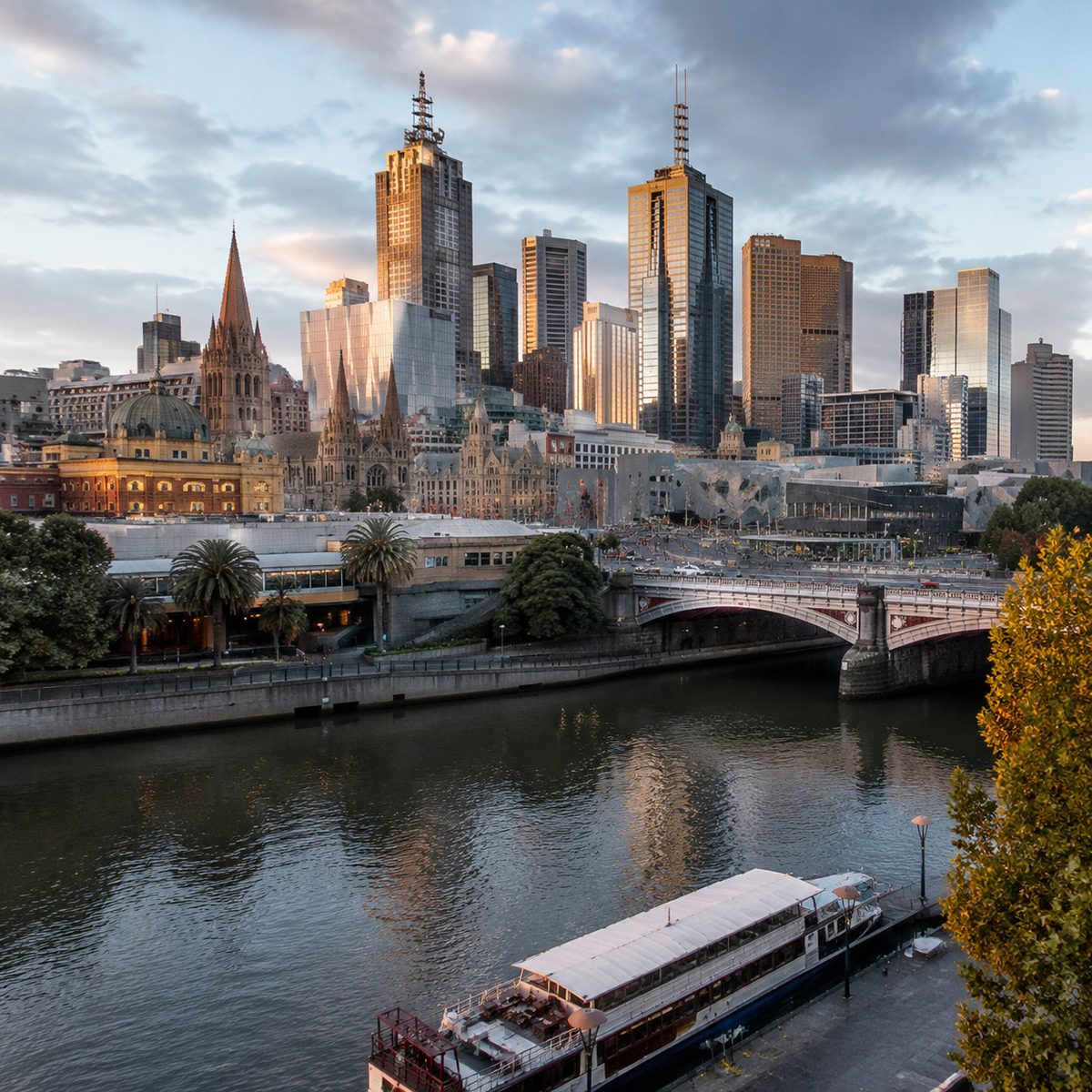
Melbourne is one of those cities that rewards the curious. Scratch the surface and you find layers — of contested history, of cultural ambition, of weather that behaves like it has a personal grudge. Most cities have a story. Melbourne has several, and they don't always agree with each other.
So when people ask what are 5 interesting facts about Melbourne, the honest answer is that five barely gets you started. But let's begin there, and go deeper.
1. Melbourne Was Named After a British Prime Minister Who Never Set Foot Here
The city takes its name from William Lamb, the 2nd Viscount Melbourne — British Prime Minister from 1834 to 1841. He was Queen Victoria's first Prime Minister and something of a political survivor, known more for his cautious pragmatism than any grand vision.
The naming happened in 1837, when Governor Richard Bourke formally proclaimed the settlement on the Yarra River. Bourke chose the name to honour Melbourne, who was then at the height of his influence in London. The irony is that Lord Melbourne never visited Australia, had no particular connection to the colony, and by most accounts showed limited interest in it.
What makes this more layered is what the naming erased. The Wurundjeri people of the Kulin Nation had lived on this land for tens of thousands of years. Their name for the area around the Yarra was Naarm — a name that is now being reclaimed and used alongside Melbourne in official contexts. The dual naming reflects a broader reckoning with how Australian cities were founded and what histories were written over in the process.
Before Bourke's proclamation, the settlement had briefly been called Batmania — after John Batman, who in 1835 negotiated a controversial and legally dubious land deal with Kulin elders. That name didn't stick, which is perhaps fortunate for the city's branding, but Batman's role in the founding remains a contested part of Melbourne's origin story.
2. The Gold Rush Didn't Just Make Melbourne Rich — It Made It Cosmopolitan
In 1851, gold was discovered in central Victoria. What followed was one of the most dramatic demographic explosions in colonial history. Melbourne's population went from roughly 29,000 in 1851 to over 120,000 by 1854. People arrived from Britain, Ireland, China, the United States, and across continental Europe — all chasing the same thing.
The gold rush is often told as an economic story, and the economics were extraordinary. By the 1880s, Melbourne was one of the wealthiest cities in the world. The grand Victorian-era buildings that still define the CBD — the Royal Exhibition Building, the State Library, the ornate terrace houses of Carlton and Fitzroy — were built on gold money. Melbourne was sometimes called Marvellous Melbourne, a phrase that captured both genuine civic pride and a certain colonial swagger.
But the deeper consequence was cultural. The gold rush forced Melbourne to become pluralistic before it was ready to. Chinese miners faced violent discrimination on the goldfields, leading to some of Australia's earliest race riots at Lambing Flat in 1861. Yet Chinese communities also established themselves permanently, building temples, businesses, and neighbourhoods that shaped Melbourne's character. The city's long history of immigration — which continued through the post-war waves of Italian, Greek, Vietnamese, and Lebanese settlement — has its roots in that chaotic, transformative gold rush decade.
Melbourne today has one of the highest proportions of overseas-born residents of any city in the world. That didn't happen by accident. It happened because the city was built, from the very beginning, by people who came from somewhere else.
3. Melbourne Played a Role in Australian History That Most People Don't Fully Appreciate
Here is a fact that surprises many people: Melbourne was the capital of Australia from 1901 until 1927.
When the six Australian colonies federated on 1 January 1901, the new Commonwealth needed a capital. Sydney and Melbourne both wanted it. The compromise — one of the more awkward diplomatic fudges in Australian political history — was that the capital would be a new city built in New South Wales, but no closer than 100 miles from Sydney. That city became Canberra. In the meantime, the federal parliament sat in Melbourne.
For 26 years, Melbourne was the seat of Australian federal government. The first parliament met in the Royal Exhibition Building in 1901 — the same building that had hosted the Melbourne International Exhibition in 1880. Federal institutions, government departments, and the High Court of Australia all operated from Melbourne during this period.
This history shaped the city's identity in ways that still resonate. Melbourne developed a strong sense of itself as a place where serious things happened — where law, culture, and civic life mattered. The city's density of cultural institutions, its legal precinct, its tradition of public intellectual life — these aren't coincidental. They reflect a period when Melbourne genuinely was the centre of Australian national life.
The move to Canberra in 1927 stung. Melbourne never quite lost the sense that it had been passed over, which may partly explain the city's enduring competitive relationship with Sydney.
4. Melbourne's Relationship With Sport Is Not Normal
Every city has sport. Melbourne has something closer to a civic religion.
The statistics are well known but still striking. Melbourne hosts the Australian Open — one of the four Grand Slam tennis tournaments. It hosts the Formula 1 Australian Grand Prix at Albert Park. It hosts the Melbourne Cup, a horse race that genuinely does stop the nation on the first Tuesday of November. It hosts the AFL Grand Final, the Boxing Day Test at the MCG, and the Australian Motorcycle Grand Prix at Phillip Island.
The Melbourne Cricket Ground — the MCG — is the largest stadium in the Southern Hemisphere, with a capacity of over 100,000. It hosted the 1956 Olympic Games and the 2006 Commonwealth Games. On Boxing Day, it fills to capacity for a cricket Test match in a way that happens nowhere else on earth.
But the numbers don't capture what makes Melbourne's sports culture genuinely interesting. Australian Rules Football — AFL — was codified in Melbourne in 1859, making it one of the oldest football codes in the world. The game was invented here, and nine of the eighteen AFL clubs are based in Melbourne. On a winter Saturday, the city reorganises itself around football. Trams fill with supporters in club colours. Conversations in cafes, on trams, in offices — they're about the footy.
What makes Melbourne unique compared to other Australian cities is partly this: sport here isn't just entertainment. It's a shared language. It's how the city talks to itself.
5. Melbourne's Weather Is a Genuine Phenomenon, Not Just Small Talk
The saying goes: four seasons in one day. It's a cliché, but clichés become clichés because they're true often enough to stick.
Melbourne sits at the bottom of a large continent, exposed to weather systems sweeping up from the Southern Ocean. Cold fronts can arrive with very little warning, dropping temperatures by 10 degrees in an hour. A morning that starts at 28°C can end at 14°C with horizontal rain. In summer, the city regularly experiences extreme heat events — days above 40°C — followed by a cool change that drops the temperature 20 degrees overnight.
What is interesting about Melbourne's weather is not just its variability but its consequences. The city's architecture, its culture of layering clothing, its obsession with café culture and indoor spaces — these are partly responses to weather that cannot be trusted. The famous laneway café scene didn't emerge purely from aesthetic preference. Laneways offer shelter. They're protected from the wind that funnels through the CBD grid.
The weather also shapes the city's relationship with its parks and gardens. On a clear Melbourne day — and there are many — the Royal Botanic Gardens, the Yarra River trails, and the bay beaches at St Kilda fill with people who understand that good weather here is not to be wasted. You take it when it comes.
The Cultural Landmarks That Carry the City's History
Melbourne's cultural infrastructure is dense for a city of its size, and most of it is concentrated in a relatively small area of the inner city.
The Royal Exhibition Building in Carlton is the only building in Australia with UNESCO World Heritage listing. Built for the 1880 Melbourne International Exhibition, it hosted the first federal parliament in 1901. It still stands, largely intact, surrounded by the Carlton Gardens.
The State Library of Victoria, opened in 1856, has one of the most extraordinary reading rooms in the world — the La Trobe Reading Room, with its octagonal dome and tiered galleries. It holds Ned Kelly's armour, which tells you something about what Victorians consider worth preserving.
The National Gallery of Victoria — the NGV — is the oldest and most visited art museum in Australia. Its international collection on St Kilda Road and its Australian collection at Federation Square between them hold works that trace both European art history and the development of Australian visual culture.
Federation Square itself, opened in 2002, was controversial when it was built — the angular, fragmented architecture divided opinion sharply. It has since become a genuine civic gathering place, which is what it was designed to be. It sits at the corner of Flinders Street and Swanston Street, directly across from Flinders Street Station — the building with the clocks that has been a meeting point for Melburnians for over a century.
The laneways — Hosier Lane, Centre Place, Degraves Street — are cultural landmarks of a different kind. They represent Melbourne's capacity to find value in leftover space, to turn service lanes into galleries and gathering places. The street art in Hosier Lane is internationally recognised. It changes constantly, which is the point.
What Actually Makes Melbourne Different
The question of what makes Melbourne unique compared to other Australian cities has a complicated answer, because Melbourne's identity has always been partly constructed in opposition to Sydney.
Sydney has the harbour and the Opera House and the beach culture. Melbourne has the laneways and the coffee and the football and the weather. Sydney is spectacular. Melbourne is liveable — or at least, that's the story Melbourne tells about itself, and it has been telling it consistently enough that it has become largely true.
For years, Melbourne topped the Economist Intelligence Unit's Global Liveability Index. The ranking measures stability, healthcare, culture, environment, education, and infrastructure. Melbourne scored consistently well across all of them. The ranking has become part of the city's self-image, which creates its own pressures — the city now has to live up to a reputation for liveability that it helped construct.
But underneath the rankings and the café culture and the football, Melbourne is a city with a genuinely complex history. It was built on dispossession. It was transformed by gold. It governed a nation for 26 years. It absorbed wave after wave of migration and became something genuinely multicultural in the process. It invented a football code and turned sport into civic identity.
None of that fits neatly into five facts. But five facts is where you start.
Getting around Melbourne to experience all of this — the MCG, Federation Square, the Royal Exhibition Building, the laneways, the bay — is straightforward on the public transport network. Metlink Melbourne operates the trains, trams, and buses that connect the city and its suburbs. The tram network alone, the largest in the world outside of Europe, is itself a piece of Melbourne history worth understanding.