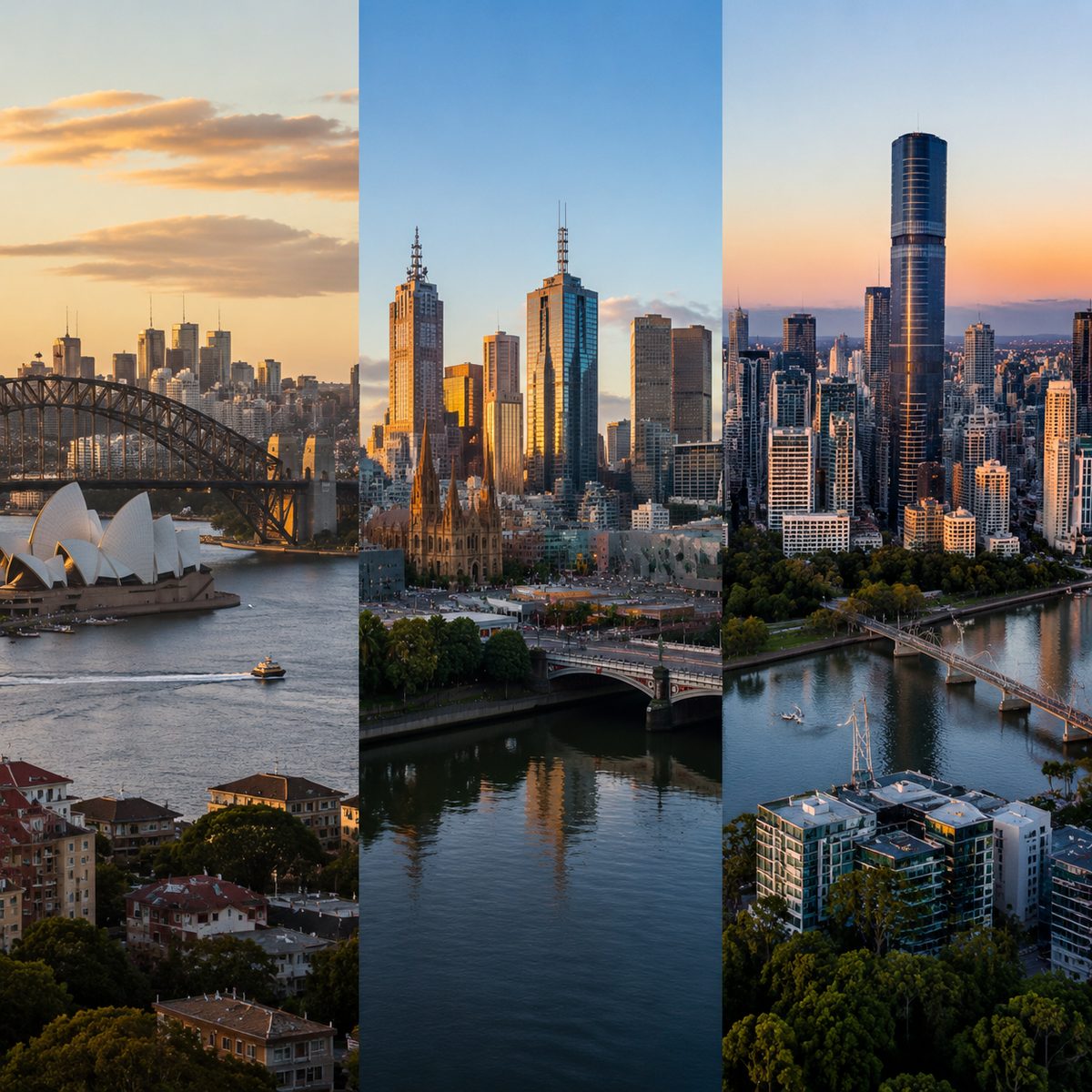
The top 3 largest cities in Australia are Sydney, Melbourne and Brisbane, and between them they hold more than half the country's entire population.
That's a remarkable fact for a continent this size. Australia is vast. It stretches across three time zones and covers nearly eight million square kilometres. Yet most Australians live within a short drive of the ocean, clustered into a handful of coastal cities that grew fast and never really stopped.
To understand these three cities is to understand modern Australia. How it was built. Where it is heading. And why the gap between the big cities and everywhere else keeps widening.
The Big Picture First
Australia has about 26 million people. Sydney holds roughly 5.3 million of them. Melbourne sits just behind at around 5.1 million. Brisbane comes in third at about 2.6 million.
Add those three together and you get nearly half the country living in three urban areas. That concentration shapes everything. Transport. Housing. Politics. Jobs. The way Australians think about themselves.
Each city grew from a colonial port. Each one spread outward rather than upward for most of its history. Each one is now grappling with the consequences of that sprawl. Traffic. Housing costs. Infrastructure strain. The familiar pressures of a city that grew faster than its planning.
Sydney: The Oldest and Still the Biggest
Sydney was the first. The British established a convict settlement at Sydney Cove in 1788 and the city has been growing ever since. It sits on one of the most beautiful natural harbours in the world and it has never been shy about that fact.
The harbour shaped everything about Sydney. The city grew around its inlets and headlands. Suburbs spread along the water. The bridge and the opera house became global symbols not just of a city but of a country finding its identity.
Sydney's population today sits at around 5.3 million people. It is the financial capital of Australia in practical terms. The major banks, the stock exchange, the headquarters of most large corporations. They are all in Sydney.
The city is also extraordinarily diverse. More than 40 percent of Sydney residents were born overseas. Suburbs like Cabramatta, Lakemba and Burwood have become genuine multicultural communities with their own economic and cultural gravity.
But Sydney has a problem that has been building for decades. Housing. The city is hemmed in by national parks to the north and south, the Blue Mountains to the west and the ocean to the east. Land is scarce. Prices reflect that scarcity. The median house price in Sydney regularly sits above one million dollars. That has pushed working families further and further from the centre, stretching commutes and straining the transport network.
Getting Around Sydney
Sydney has trains, buses, light rail and ferries. The ferry network is genuinely world class. Commuting by water across the harbour is one of the great urban experiences anywhere.
The train network is older and more limited than Melbourne's. Sydney built its rail system later and with less ambition. The result is a city that remains heavily car dependent outside the inner suburbs.
Melbourne: The Rival That Caught Up
Melbourne was founded in 1835, nearly fifty years after Sydney. It grew fast on the back of the gold rush of the 1850s and by the 1880s it was one of the wealthiest cities in the world. Marvellous Melbourne, they called it. Grand buildings. Wide boulevards. A tram network that became the largest in the world outside Europe.
Then came the crash of the 1890s. Melbourne fell hard. Sydney pulled ahead. And for most of the twentieth century Melbourne sat in second place, always the bridesmaid, always slightly resentful of its northern rival.
That rivalry is real and it is old. Melburnians will tell you their city has better coffee, better food, better culture and better sport. Sydneysiders will tell you they have the harbour. Both are right about their own claims.
Melbourne's population is now around 5.1 million and it is closing the gap with Sydney fast. For most of the past decade Melbourne has been the fastest growing major city in Australia. Some projections suggest it will overtake Sydney in total population within the next ten to fifteen years.
The city spreads across the flat plains of the Port Phillip basin. It has no natural barriers to growth the way Sydney does. That has allowed Melbourne to sprawl in ways that are both impressive and alarming. The outer suburbs now stretch forty kilometres from the city centre in some directions.
Melbourne's Trams and Urban Character
The tram network is the thing that most distinguishes Melbourne's urban experience. Over 250 kilometres of track. More than 1700 tram stops. The network runs through the inner and middle suburbs in a way that shapes how people move and where they choose to live.
Trams are slow. They get stuck in traffic. But they are also frequent, reliable and deeply woven into the city's identity. Neighbourhoods built around tram lines have a different character to those built around cars. Denser. More walkable. More likely to have a local cafe or bookshop at street level.
Melbourne's train network is also more extensive than Sydney's, with a loop system through the CBD and lines reaching most major suburbs. The city invested heavily in rail during the postwar decades and that investment still pays dividends.
For anyone using public transport in Melbourne, Metlink Melbourne is the central resource for timetables, route planning and service updates across trains, trams and buses.
Brisbane: The Third City Coming Fast
Brisbane is different from Sydney and Melbourne in ways that go beyond size. It is younger in feel. Less formal. The climate is subtropical and that shapes how people live. Outdoor dining. Backyard pools. A pace of life that feels genuinely distinct from the southern cities.
The city sits on the Brisbane River in southeast Queensland. It was established as a penal colony in 1824 and remained a relatively small regional centre for most of its history. The transformation came in the second half of the twentieth century. The 1988 World Expo put Brisbane on the map. The 2000 Olympics in Sydney sent a wave of interstate migration northward. And the mining boom of the 2000s brought money and people in large numbers.
Brisbane's population is now around 2.6 million. That makes it roughly half the size of Sydney and Melbourne. But the growth rate is extraordinary. Queensland as a whole has been absorbing interstate migrants at a pace that no other state can match.
The 2032 Olympics will be held in Brisbane. That has accelerated infrastructure investment and urban renewal in ways that will reshape the city over the next decade. New stadiums. New transport links. New precincts along the river.
Southeast Queensland as a Region
Brisbane does not exist in isolation. The southeast Queensland region includes the Gold Coast to the south and the Sunshine Coast to the north. Together these form a continuous urban corridor of around 3.8 million people.
The Gold Coast alone has about 700,000 residents. It is the sixth largest city in Australia by some measures. The Sunshine Coast is growing even faster in percentage terms.
This regional dynamic makes Brisbane's story more complex than a simple population number suggests. The city is the centre of a much larger urban system that is reshaping the geography of Australian population.
Is Canberra One of the Largest Cities in Australia?
No. Canberra is the capital of Australia but it is not one of the largest cities. Its population is around 470,000. That makes it the eighth largest urban area in the country.
Canberra was purpose built as a compromise between Sydney and Melbourne, both of which wanted to be the national capital. The site was chosen in 1908 and the city was designed from scratch on an empty plain. It has wide streets, abundant parkland and a planned quality that real cities rarely achieve.
It is also a government town. The public service dominates the economy. That gives Canberra a stability and an affluence that other cities envy, but it also gives it a certain sameness. The city lacks the industrial history, the immigrant waves and the economic turbulence that shaped Sydney, Melbourne and Brisbane.
Which Australian City Is Growing the Fastest?
Brisbane and southeast Queensland are growing the fastest in absolute terms among the major cities. But Perth in Western Australia has also had periods of extraordinary growth tied to the mining sector.
Melbourne has been the fastest growing of the two largest cities for most of the past decade. Its population grew by more than 100,000 people in some years before the pandemic. That growth has resumed and is accelerating again.
The drivers of growth are similar across all three cities. Interstate migration. Overseas immigration. A concentration of jobs, universities and services that makes the big cities attractive to young people from regional areas and from overseas.
The consequence of that growth is pressure. On housing. On transport. On schools and hospitals. On the urban fabric itself. Every major Australian city is struggling to build enough homes and infrastructure to keep pace with the people arriving.
Are the Largest Cities in Australia Located on the Coast?
Yes. Almost entirely. Sydney, Melbourne and Brisbane are all coastal cities. So are Perth, Adelaide and the Gold Coast. The pattern is consistent and it is not accidental.
Australia was colonised from the sea. The first settlements were ports. The economy was built on exports that moved through those ports. The railways that connected the interior all ran back to the coast. The cities that grew were the ones with good harbours or river access to the sea.
The interior of Australia is largely arid. The population that lives there is small and scattered. The coastal fringe, particularly the southeast and southwest corners of the continent, has the rainfall, the temperate climate and the agricultural land that supported dense settlement.
That coastal concentration has only deepened over time. As the economy shifted from agriculture and mining to services and knowledge industries, the advantages of the big coastal cities grew stronger. They have the universities, the hospitals, the airports and the cultural institutions. They attract the people. The people attract more investment. The cycle continues.
The Sydney versus Melbourne Question
Sydney is currently the largest city in Australia by population. Melbourne is closing the gap and may overtake it within fifteen years if current trends continue.
The rivalry between the two cities is one of the great ongoing arguments in Australian life. It is partly about size. Partly about character. Partly about which city better represents what Australia is and wants to be.
Sydney has the harbour, the beaches and the global profile. It is the city most overseas visitors think of when they think of Australia. Melbourne has the laneways, the coffee culture, the arts scene and the sport. It is the city most Australians who live there will defend with genuine passion.
Both cities are world class in different ways. Both are expensive, sprawling and under pressure. Both are trying to figure out how to grow without losing what makes them worth living in.
What This Means for How Australians Live
The concentration of population in three coastal cities has profound consequences for Australian life. It means that decisions made in Sydney, Melbourne and Brisbane shape the country in ways that decisions made anywhere else simply cannot match.
It means that housing affordability is a national crisis centred on those three cities. It means that transport investment flows to those cities. It means that political power follows population and population follows the coast.
For anyone living in or moving to one of these cities, understanding how they work, how to get around them and how they are changing is genuinely useful. The transport networks in particular are complex and constantly evolving as cities try to manage growth.
Frequently Asked Questions
What are the top 3 largest cities in Australia?
Sydney, Melbourne and Brisbane are the top 3 largest cities in Australia by population.
Is Sydney or Melbourne the largest city in Australia?
Sydney is currently the largest city in Australia with around 5.3 million people, ahead of Melbourne's 5.1 million.
What is the population of Brisbane compared to Sydney and Melbourne?
Brisbane has around 2.6 million people, roughly half the population of either Sydney or Melbourne.
Is Canberra one of the largest cities in Australia?
No, Canberra has around 470,000 people and is the eighth largest urban area in Australia.
Which Australian city is growing the fastest?
Brisbane and southeast Queensland are growing fastest overall, while Melbourne has been the fastest growing of the two largest cities for most of the past decade.
Are the largest cities in Australia located on the coast?
Yes, all of Australia's largest cities are coastal, a pattern rooted in the country's colonial origins as a network of seaports.