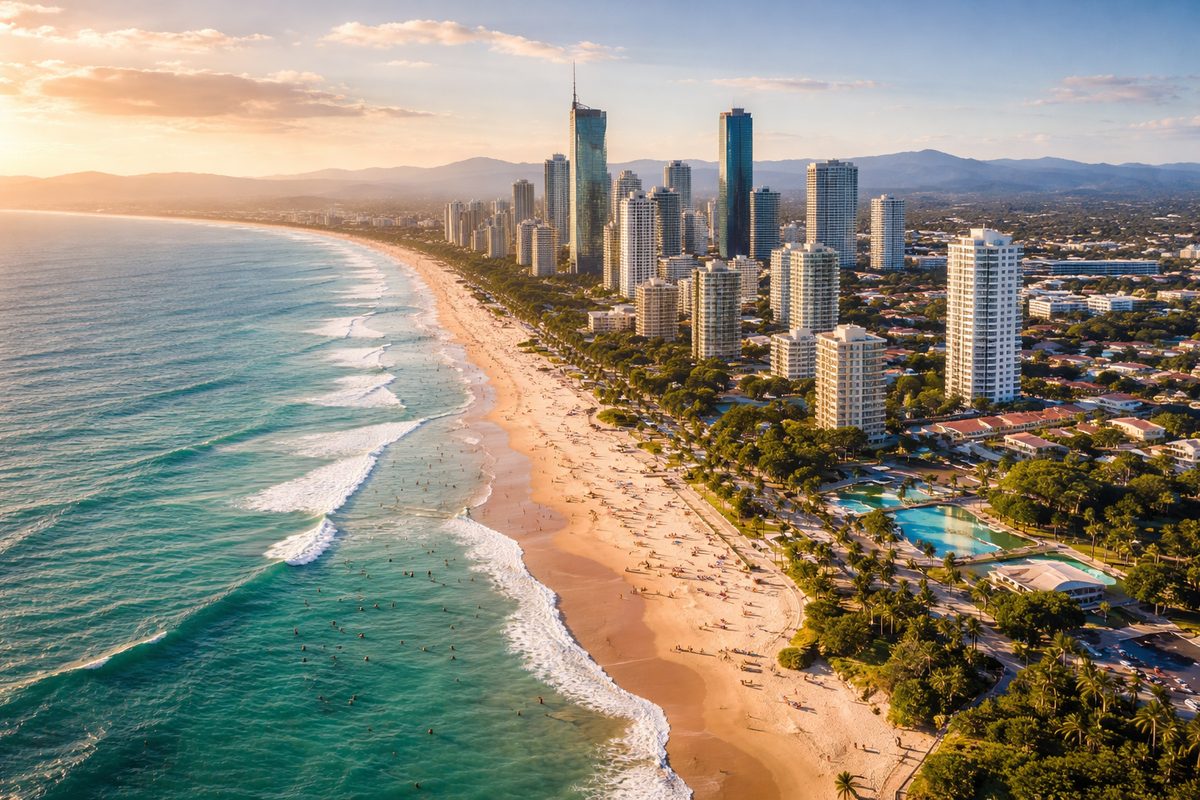
Where do 80% of Australians live? They live within 50 kilometres of the coast, packed into a thin ribbon of cities and towns hugging the edge of a continent that is mostly empty.
Think about that for a moment. Australia is the sixth largest country on Earth. It covers nearly 7.7 million square kilometres. Yet almost all of its 26 million people are squeezed into a coastal fringe that makes up a tiny fraction of that land mass. The interior is vast, ancient, and largely silent.
This is not an accident. It is the result of geography, climate, history, and economics all pushing in the same direction at once. Understanding why Australians live where they do tells you something deep about the country itself.
The Big Picture: A Country of Coastal Cities
Australia is one of the most urbanised countries in the world. Around 90 percent of Australians live in urban areas. Of those, the overwhelming majority live in the capital cities of each state and territory.
Sydney and Melbourne alone account for roughly 40 percent of the entire national population. Add Brisbane, Perth, Adelaide, and the other capitals, and you have captured the vast majority of where Australians actually live, work, and move around.
This concentration is extraordinary by global standards. Most large countries have population spread more evenly across their territory. Australia does not. The centre of the continent, the famous outback, holds only a tiny fraction of the population despite covering most of the land area.
The coastal cities are not just where people live. They are where the economy runs, where the universities sit, where the hospitals are, where the trains and trams connect people to jobs. The infrastructure of Australian life is a coastal infrastructure.
Why Do Most Australians Live on the Coast?
The short answer is water and climate. The long answer involves everything from colonial history to the limits of what the land can support.
When British settlers arrived in 1788, they came by sea and they stayed near the sea. The first settlements were ports. Sydney Cove, Port Phillip Bay, the Swan River. These were not random choices. They were practical ones. Ships brought supplies. Ships took away wool and wheat and gold. The coast was the connection to the world.
As the colonies grew, the coastal capitals became the centres of government, trade, and population. The railways that eventually pushed inland all radiated outward from these coastal hubs. The interior was opened up to serve the coast, not to rival it.
Then there is the climate. The interior of Australia is brutally hot and dry. The Simpson Desert, the Nullarbor, the vast red centre. These are not places that support large settled populations without enormous effort and expense. The coast, by contrast, offers milder temperatures, reliable rainfall in many areas, and the psychological comfort of the ocean.
Australians have always known, at some level, that the land beyond the ranges is hard country. The coast felt safer, more familiar, more connected to the world they came from.
What Percentage of Australians Live in Cities?
Approximately 90 percent of Australians live in urban areas. This makes Australia one of the most urbanised nations on the planet, sitting alongside countries like Belgium, Japan, and the United Kingdom.
But the Australian version of urbanisation has a particular shape. It is not spread across dozens of medium-sized cities the way Germany is, for example. It is concentrated in a small number of very large cities, most of them on the coast.
The capital cities dominate in a way that has no real parallel in comparable countries. In most nations, the capital is one major city among several. In Australia, the state capitals are the centres of gravity for everything. Population, jobs, culture, sport, politics. It all flows through them.
This pattern has been reinforcing itself for over two centuries. The bigger the cities got, the more services and opportunities they offered. The more they offered, the more people moved there. Regional and rural Australia has been losing population share, not gaining it, for most of the past century.
Which City Has the Largest Population in Australia?
Sydney and Melbourne have been trading the title of Australia's largest city for decades. As of the mid-2020s, Sydney holds a slight edge with around 5.3 million people, while Melbourne sits close behind at around 5.1 million and growing fast.
Melbourne's growth story is particularly striking. For much of the twentieth century, Sydney was clearly the larger city. But Melbourne has been closing the gap steadily, driven by strong migration, a reputation for liveability, and a diverse economy. Some projections suggest Melbourne could overtake Sydney in population within the next decade or two.
Brisbane is the third largest city, with around 2.5 million people in its greater metropolitan area. It has been growing rapidly, partly driven by interstate migration from Sydney and Melbourne where housing costs have become extreme.
Perth sits on the other side of the continent, geographically isolated from the eastern seaboard cities, with around 2.1 million people. Adelaide has around 1.4 million. These five cities together hold the great majority of all Australians.
For anyone thinking about urban transport and movement in Melbourne specifically, the scale of the city matters enormously. Getting 5 million people around a sprawling metropolitan area requires serious infrastructure. That is the challenge that services like Metlink Melbourne exist to address, connecting suburbs, trains, trams, and buses into a network that makes the city function.
How Much of Australia Is Uninhabited or Sparsely Populated?
The numbers here are genuinely staggering. Roughly 70 percent of Australia is classified as arid or semi-arid. Large portions of the continent have population densities of less than one person per square kilometre. Some areas have essentially no permanent population at all.
The Northern Territory covers 1.35 million square kilometres. It has around 250,000 people. That is a population density so low it barely registers on a global scale. The same story plays out across much of Western Australia, South Australia, and Queensland beyond the coastal strip.
Australia's overall population density is around 3.5 people per square kilometre. But that average is deeply misleading. In the coastal cities, density is high and rising. In the interior, it is close to zero. The average tells you almost nothing about how the country actually works.
The outback is not empty because nobody tried to settle it. People did try. The history of inland Australia is full of failed towns, abandoned farms, and communities that could not survive the combination of drought, distance, and economic marginalisation. The land pushed back, and most people eventually moved toward the coast.
Indigenous Australians have lived across the continent for over 60,000 years, including in the interior. Their relationship with the land is fundamentally different from the European settler model. But even within Indigenous communities, there has been significant movement toward towns and cities over the past century, driven by access to services, education, and employment.
Population Distribution of Australia by State
New South Wales is the most populous state, with around 8.3 million people. The vast majority of them live in or around Sydney. The rest of the state, which is enormous, holds a much smaller share.
Victoria comes second with around 6.7 million people, again concentrated heavily in Melbourne. Victoria is actually the most densely populated state in Australia, but only because its population is so tightly packed into the south-eastern corner around Port Phillip Bay.
Queensland has around 5.4 million people, spread more widely than the southern states but still concentrated in the south-east corner around Brisbane and the Gold Coast. The tropical north, despite its size, holds a small fraction of the state's population.
Western Australia has around 2.8 million people, almost all of them in Perth. The rest of the state, which is larger than Western Europe, has a tiny population scattered across mining towns, agricultural areas, and remote communities.
South Australia has around 1.8 million people, with Adelaide dominating completely. The Northern Territory has around 250,000. The Australian Capital Territory, which is essentially Canberra, has around 460,000. Tasmania has around 570,000.
The pattern is consistent across every state and territory. The capital city dominates. The regions hold a smaller and often declining share. The interior is largely empty.
What This Means for How Australians Actually Live
When you understand this distribution, a lot of things about Australian life start to make sense.
The political debates about infrastructure investment make sense. When most of the population is in five coastal cities, that is where the pressure for roads, rail, hospitals, and schools is most intense. Regional communities often feel overlooked because, in terms of raw numbers, they represent a small share of the electorate.
The housing affordability crisis makes sense. When population growth is concentrated in a small number of cities, and those cities have geographic constraints on expansion, prices rise. Sydney and Melbourne have some of the least affordable housing in the world relative to incomes, precisely because so many people want to live there and the supply of well-located land is limited.
The importance of public transport makes sense. A city of five million people cannot function if everyone drives everywhere. The tram network in Melbourne, one of the largest in the world, exists because the city grew up around it. The train lines that reach into the suburbs carry hundreds of thousands of people every day. Without that network, the city would grind to a halt.
The coastal concentration also shapes Australian culture in ways that are easy to overlook. The beach is central to Australian identity not just because Australians like swimming. It is central because most Australians live close enough to the coast to make it part of their regular life. The beach is accessible in a way it simply is not for people living in the interior of large continents.
Is This Pattern Changing?
There are signs of some shift, but the fundamental pattern is remarkably stable. The COVID-19 pandemic prompted a wave of commentary about Australians leaving the big cities for regional areas. And there was real movement. Towns within a few hours of Sydney and Melbourne saw population and property price increases.
But the cities kept growing too. The net effect was not a reversal of urbanisation. It was more like a slight spreading of the coastal fringe. People moved to Geelong, Ballarat, the Sunshine Coast, the Hunter Valley. These are not the outback. They are still coastal or near-coastal areas with good transport links to the major cities.
The structural forces that created Australia's coastal concentration have not gone away. The interior is still hot, dry, and distant from services. The coastal cities still offer the jobs, the universities, the hospitals, the cultural life. Until those fundamentals change, the pattern will persist.
Australia will remain what it has been for most of its European history. A vast, largely empty continent with a thin, dense, busy coastal edge where almost everyone lives.
Frequently Asked Questions
Where do 80% of Australians live?
80 percent of Australians live within 50 kilometres of the coastline, concentrated in the major capital cities.
Why do most Australians live on the coast?
The coast offered the first settlers access to trade, milder climate, and reliable water, and those advantages have compounded over two centuries of urban growth.
What percentage of Australians live in cities?
Around 90 percent of Australians live in urban areas, making Australia one of the most urbanised countries in the world.
Which city has the largest population in Australia?
Sydney is currently Australia's largest city with around 5.3 million people, though Melbourne is growing fast and may overtake it.
How much of Australia is uninhabited or sparsely populated?
Roughly 70 percent of Australia is arid or semi-arid, with vast interior regions holding population densities close to zero.
What is the population distribution of Australia by state?
New South Wales leads with 8.3 million people, followed by Victoria at 6.7 million, Queensland at 5.4 million, and Western Australia at 2.8 million, with each state's population dominated by its capital city.